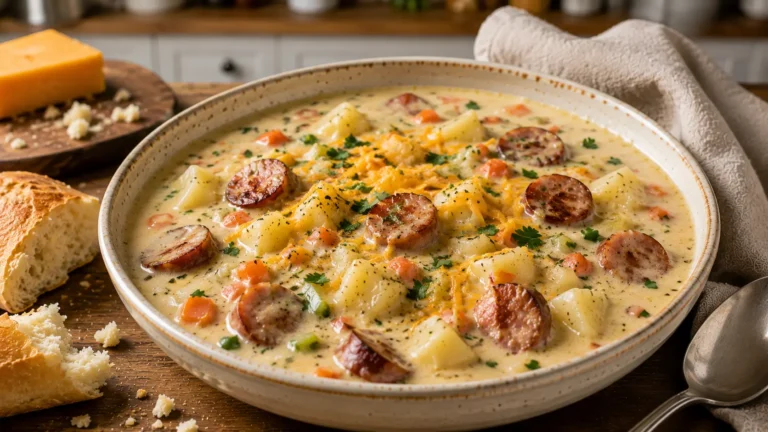
Brown Butter Sage Roasted Turkey Breast for Two
A full Thanksgiving turkey is wonderful when you’re feeding a crowd, but it doesn’t make much sense when dinner is just for two. This Brown Butter Sage Roasted Turkey Breast gives you everything you want from a holiday turkey—golden skin, juicy meat, buttery pan juices, garlic, and plenty of fresh herbs—without committing to an entire bird.
The flavor starts with brown butter, cooked just until the milk solids turn golden and nutty. Fresh sage, thyme, garlic, and lemon are stirred into that butter before it’s rubbed over and underneath the turkey skin. As the breast roasts, those herbs perfume the meat while the butter helps the exterior become beautifully browned and crisp.
It’s an especially useful recipe for a small Thanksgiving dinner, Christmas dinner for two, or cozy Sunday roast. Add a seasonal salad and roasted vegetables, and you can build an impressive holiday meal without spending the entire day in the kitchen.
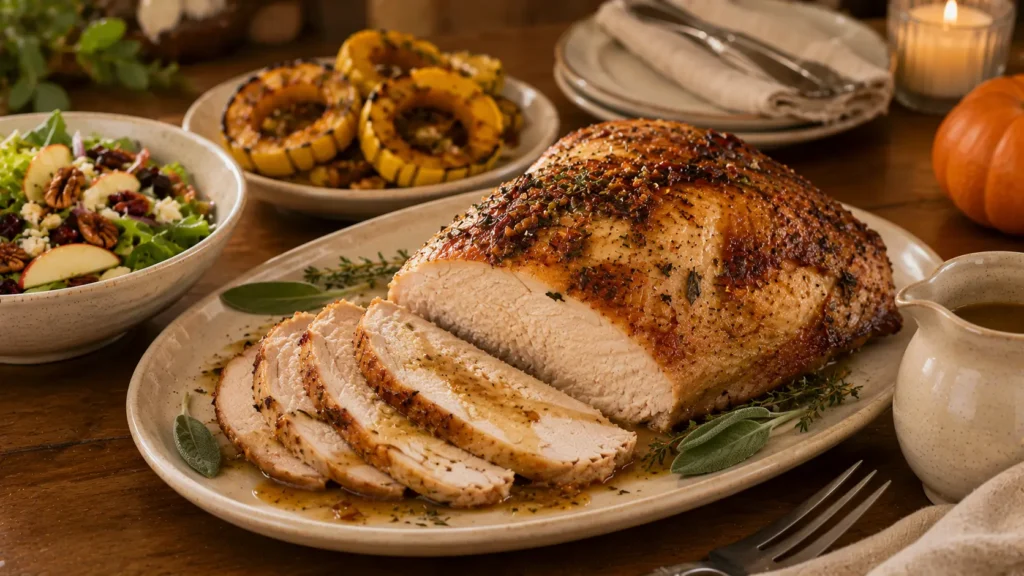
Easy Roasted Turkey Breast for Two
Cooking only the turkey breast solves several problems that come with roasting a whole bird.
It’s easier to handle, takes less time, and gives you a manageable amount of leftovers. More importantly, if you’re primarily interested in tender white meat and crisp skin, you aren’t cooking extra parts simply because tradition says you need a whole turkey.
For this recipe, I recommend a small bone-in, skin-on turkey breast, ideally around 2½–3 pounds.
The bone helps protect the meat while it roasts, while the skin gives us somewhere to spread our brown butter and herb mixture.
Cooking time should always be treated as an estimate. Turkey breast size, starting temperature, roasting pan, and individual ovens all affect how quickly it cooks. The reliable way to determine doneness is with a food thermometer: USDA guidance specifies 165°F (74°C) as the safe minimum internal temperature for turkey breast.
⭐ Why You’ll Love This Recipe
- Designed for two. No enormous turkey required.
- Perfect for a small Thanksgiving.
- Brown butter adds incredible flavor.
- Fresh sage and thyme make it taste distinctly autumnal.
- Bone-in turkey breast stays beautifully juicy when properly cooked.
- Crispy golden skin without complicated techniques.
- Much easier to carve than a whole turkey.
- Simple ingredients with an impressive result.
- Enough leftovers for a couple of sandwiches without filling the refrigerator with turkey for a week.
- Works beyond Thanksgiving. It’s equally good for Christmas or a cozy weekend roast.
🛒 Ingredients
Bone-In, Skin-On Turkey Breast
Use approximately 2½–3 pounds of bone-in, skin-on turkey breast.
For a recipe designed for two, that gives you generous portions and potentially some leftovers.
Choose a fully thawed breast and check the package to see whether it has been pre-brined or injected with a salt solution. If it has, reduce the additional salt accordingly.
USDA recommends thawing turkey safely in the refrigerator, cold water, or microwave rather than leaving it on the counter. Refrigerator thawing is the easiest method when you can plan ahead.
Unsalted Butter
You’ll need 5 tablespoons unsalted butter.
We’re going to brown it before combining it with our seasonings.
Browning butter cooks the milk solids until they become golden, producing a deep nutty aroma that regular melted butter doesn’t have.
Fresh Sage
Sage and turkey are classic partners for good reason.
Finely chop approximately 1 tablespoon fresh sage for the butter mixture and keep a few whole leaves for the roasting pan or garnish.
Fresh Thyme
Fresh thyme adds a slightly lighter herbal note that balances the stronger sage.
Strip the tiny leaves from the stems before chopping.
Garlic
Use 3 fresh garlic cloves, finely grated or minced.
Garlic goes into the brown butter mixture so its flavor spreads over the entire breast.
Lemon
We’ll use both a little lemon zest and fresh lemon in the roasting pan.
The acidity and citrus aroma help cut through the richness of the butter.
Salt
Salt seasons the turkey throughout.
Again, check the turkey packaging before seasoning aggressively because some turkey breasts already contain added salt.
Black Pepper
Freshly ground black pepper gives the herb butter a gentle bite.
Olive Oil
A small amount of olive oil can be mixed with the brown butter to make it easier to spread once the butter begins cooling.
Onion
One small onion, cut into thick wedges, creates an aromatic base beneath the turkey.
Chicken or Turkey Broth
A small amount of low-sodium broth in the bottom of the roasting pan helps prevent the drippings from scorching.
Those drippings can later be spooned over the sliced turkey.
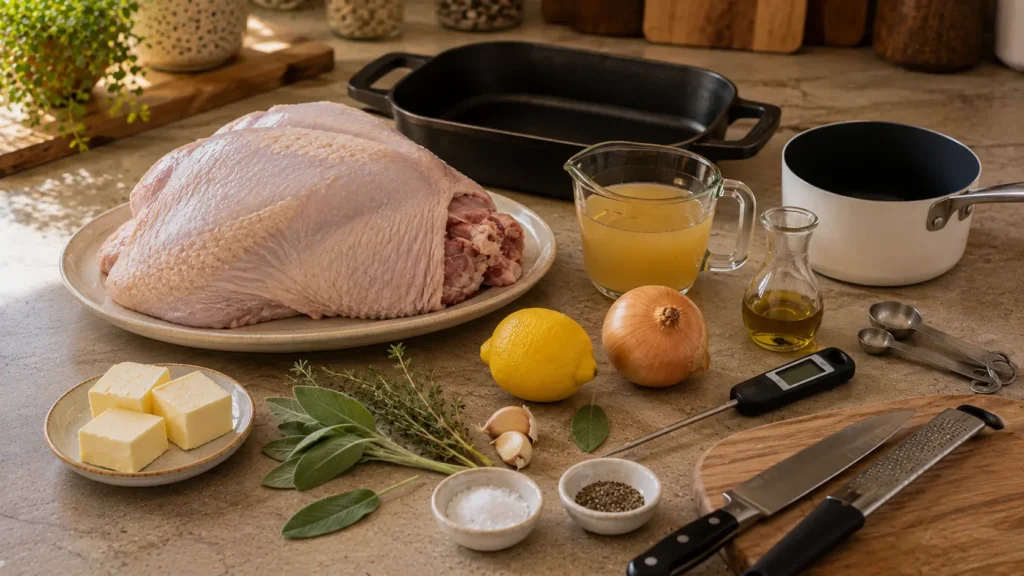
👩🍳 How to Make Brown Butter Sage Roasted Turkey Breast
1. Thaw the turkey completely
If you’re starting with frozen turkey breast, make sure it’s completely thawed before roasting.
The safest and easiest approach is refrigerator thawing.
2. Remove it from the refrigerator
Take the turkey breast from the refrigerator approximately 30 minutes before preparation.
You don’t need to leave it sitting out for a long period.
3. Preheat the oven
Preheat your oven to 375°F (190°C).
Position a rack in the lower-middle portion of the oven so the turkey has enough room above it.
4. Prepare the roasting pan
Place thick onion wedges, several thyme sprigs, sage leaves, and lemon slices in a small roasting pan or oven-safe skillet.
Add approximately ½ cup low-sodium broth.
Set aside.
5. Pat the turkey dry
Use paper towels to thoroughly pat the turkey breast dry.
This is particularly important for crispy skin.
Moisture on the exterior works against browning.
6. Brown the butter
Place the butter in a small light-colored saucepan over medium heat.
Allow it to melt.
Continue cooking while gently swirling the pan.
The butter will foam, and then you’ll begin seeing golden-brown milk solids forming at the bottom.
7. Watch carefully
As soon as the butter smells nutty and the milk solids become deep golden rather than black, remove the pan from the heat.
Brown butter can burn quickly once it reaches this stage.
8. Add the aromatics
Let the brown butter cool for a minute or two.
Stir in:
- chopped sage
- fresh thyme leaves
- garlic
- lemon zest
- black pepper
- olive oil
Add salt according to whether your turkey has already been salted or brined.
9. Loosen the skin
Carefully slide your fingers underneath the turkey skin, separating it gently from the breast meat.
Don’t remove it.
Create enough space to spread some of the herb butter directly over the meat.
10. Season underneath the skin
Spoon approximately one-third of the brown butter mixture underneath the skin.
Spread it over the breast meat as evenly as possible.
11. Season the exterior
Rub the remaining brown butter mixture all over the skin and exposed sides of the turkey.
Don’t worry if a few herb pieces collect unevenly.
That homemade irregularity is exactly what we want.
12. Position the turkey
Place the turkey skin-side up over the aromatic vegetables and herbs in your roasting pan.
The skin should remain uncovered.
13. Insert a thermometer if using a probe
Place the probe into the thickest part of the breast, avoiding contact with bone.
USDA recommends measuring poultry parts in the thickest area and keeping the thermometer away from bone.
14. Begin roasting
Transfer the turkey to the oven.
Roast uncovered.
15. Check the pan
After approximately 30 minutes, look at the bottom of the roasting pan.
If the liquid has completely evaporated and the drippings are beginning to scorch, carefully add a small splash of broth.
16. Watch the skin
If the skin reaches a beautiful deep golden color before the meat is fully cooked, loosely tent the breast with foil.
Don’t wrap it tightly.
17. Begin checking the temperature
For a small breast, start checking earlier rather than relying on a fixed roasting time.
Turkey breast size and shape vary substantially.
18. Cook to a safe temperature
Continue roasting until the thickest portion of the turkey breast reaches 165°F (74°C) when measured with a food thermometer, avoiding the bone.
For a 2½–3-pound breast at 375°F, expect roughly 60–90 minutes, but temperature—not the clock—determines doneness.
19. Remove from the oven
Carefully transfer the roasted turkey breast to a clean cutting board or serving platter.
20. Rest the turkey
Let it rest for approximately 15–20 minutes before carving.
Resting gives the hot juices time to settle and makes carving easier.
21. Prepare the pan juices
While the turkey rests, remove large herb stems and lemon pieces from the roasting pan.
Spoon excess fat from the surface if desired.
Taste the remaining juices.
If they’re intensely concentrated, dilute them with a small amount of warm broth.
22. Carve
Run a sharp knife along the breastbone and carefully remove a large section of breast meat.
Then slice the meat across the grain.
23. Serve
Arrange several slices on a warm serving platter.
Spoon a little of the brown butter pan juice over the turkey.
Add a few fresh sage or thyme leaves for presentation if desired.
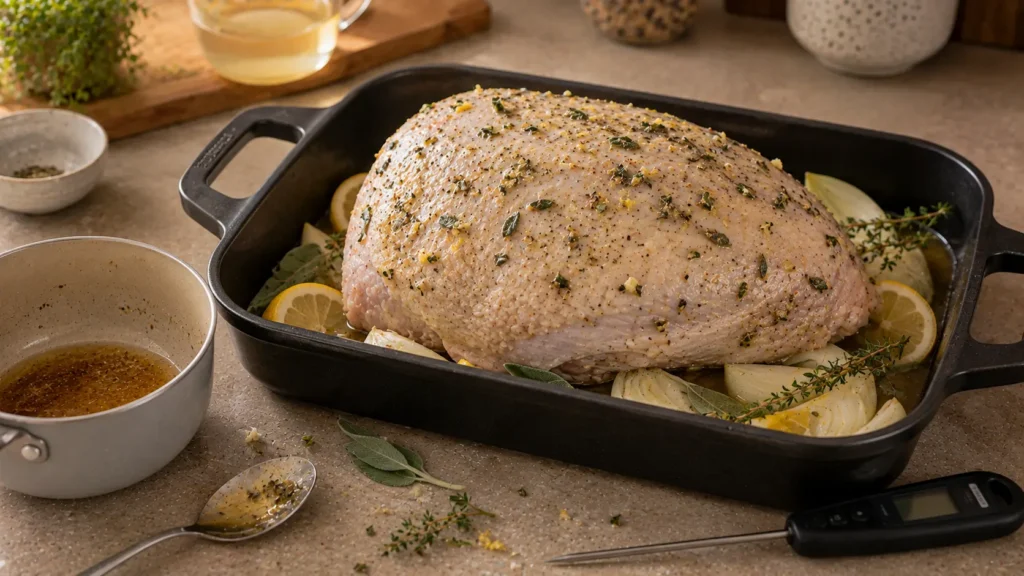
🍽️ Equipment Needed
You don’t need a giant Thanksgiving roasting setup.
Use:
- Small roasting pan or oven-safe skillet
- Small light-colored saucepan
- Sharp chef’s knife
- Cutting board
- Measuring spoons
- Measuring cup
- Microplane or fine grater
- Paper towels
- Instant-read or probe food thermometer
- Aluminum foil
- Serving platter
Don’t skip the thermometer
For this particular recipe, a thermometer isn’t merely useful—it removes the guesswork.
Turkey breast can look browned outside before the center is ready, and roasting times vary according to size and oven performance.
🔁 Variations & Substitutions
Garlic Herb Turkey Breast
Skip browning the butter.
Combine softened butter with garlic, sage, thyme, parsley, lemon zest, salt, and pepper.
You’ll lose the nutty brown-butter flavor, but the turkey will still be delicious.
Rosemary Sage Turkey
Add approximately 1 teaspoon finely chopped rosemary to the herb butter.
Rosemary is strong, so don’t use too much.
Boneless Turkey Breast
A boneless breast can work, but cooking time will change considerably.
Use the thermometer rather than adapting the bone-in timing blindly.
Orange Sage Turkey
Replace the lemon zest with orange zest.
Orange works especially well if your side dishes contain cranberry.
Maple Brown Butter Turkey
Add approximately 1 teaspoon pure maple syrup to the finished brown butter mixture.
Keep the amount small because sugar can encourage faster browning.
Dijon Herb Turkey
Whisk 1 teaspoon Dijon mustard into the herb butter.
It adds subtle acidity and savory depth without making the turkey taste strongly of mustard.
💡 Pro Tips for Juicy Turkey Breast
Buy skin-on turkey
If crispy golden skin is part of what you’re after, don’t buy skinless turkey breast.
Dry the skin thoroughly
Surface moisture interferes with browning.
Put butter under the skin
Seasoning only the outside means the skin receives most of the flavor.
Getting herb butter directly against the meat makes a noticeable difference.
Use fresh herbs when possible
Dried herbs can work, but fresh sage and thyme give this simple holiday roast much more character.
Don’t burn the brown butter
Golden-brown milk solids = nutty.
Black milk solids = bitter.
Remove the saucepan from the heat as soon as you smell that toasted, nutty aroma.
Don’t constantly open the oven
Every time you open the door, heat escapes.
Use a probe thermometer if you have one.
Trust temperature over time
This is worth repeating.
Two turkey breasts weighing exactly the same can still have different shapes and cook at different rates.
Let it rest
Don’t carve immediately after removing the turkey from the oven.
🧊 Storage & Reheating
Turkey leftovers should be refrigerated promptly rather than sitting on the Thanksgiving table all evening.
USDA recommends refrigerating perishable leftovers within 2 hours and storing cooked turkey in the refrigerator for 3–4 days.
Refrigerator
Remove the remaining meat from the bone and transfer it to an airtight container.
Add a spoonful of pan juices or broth to help preserve moisture.
Refrigerate for up to 3–4 days.
Reheating
Turkey breast can dry out quickly when reheated.
Place slices in a small baking dish with a splash of broth or pan juices.
Cover and warm gently until thoroughly hot.
USDA recommends reheating leftovers to 165°F (74°C).
Freezing
Slice the cooled turkey and place portions in freezer-safe containers with a little broth or pan juice.
USDA lists about 4 months as a best-quality freezer period for cooked turkey, although properly frozen food can remain safe longer.
❓ Frequently Asked Questions
How much turkey breast do I need for two people?
A 2½–3-pound bone-in turkey breast is generous for two people because part of that weight is bone and skin.
You’ll likely have some leftovers, which is useful for sandwiches or another meal.
What temperature should turkey breast reach?
Turkey breast should reach a safe minimum internal temperature of 165°F (74°C) in its thickest portion.
Where do I put the thermometer?
Insert it into the thickest area of the breast without touching the bone.
How long does a 3-pound turkey breast take?
At 375°F, a small 2½–3-pound breast may take roughly 60–90 minutes, but this is only an estimate.
Shape, bone structure, starting temperature, pan material, and oven accuracy can all change cooking time.
Use the internal temperature to decide when it’s ready.
Can I make this with boneless turkey breast?
Yes.
The cooking time will likely be shorter, so start checking its internal temperature early.
Do I need to baste turkey breast?
No.
The brown butter underneath the skin already adds fat and flavor directly where we need it.
Repeated basting also requires opening the oven frequently.
Why is my turkey breast dry?
Overcooking is the most common reason.
Use a thermometer rather than waiting for a specific roasting time.
What if the skin browns too quickly?
Loosely cover the browned area with aluminum foil and continue roasting until the center reaches the correct temperature.
Can I prepare the herb butter ahead?
Yes.
Prepare it a day ahead, refrigerate it, then allow it to soften enough to spread before using.
Can I season the turkey the night before?
Yes.
You can season the breast and refrigerate it uncovered overnight. This can also help dry the skin.
However, reduce or omit additional salt if your turkey was already brined or injected with a salt solution.
🍽️ What to Serve With Turkey Breast for Two
For a small Thanksgiving dinner, I’d keep the sides seasonal but manageable rather than cooking six different casseroles.
Start with the Fresh Apple Pecan Salad with Maple Vinaigrette we just made. Its crisp apples, greens, cranberries, and acidic dressing provide a fresh contrast to the rich brown-butter turkey.
Then add Brown Sugar Roasted Delicata Squash Rings. Their caramelized edges and subtle maple sweetness pair naturally with sage and turkey without requiring another complicated casserole.
If you want soup before dinner, a small bowl of Creamy Butternut Squash Soup continues the autumn theme and can be prepared ahead.
And if you’re serving an appetizer, Baked Brie with Honey, Pecans & Cranberries makes sense for a holiday meal for two—just prepare a smaller portion so you still have room for the turkey.
For a simple plate, though, I’d choose:
Brown butter turkey + apple pecan salad + delicata squash.
That’s enough to make dinner feel special without turning a meal for two into an all-day catering operation.
📊 Approximate Nutrition
Per serving, assuming 2 generous servings and not consuming every drop of pan butter:
Calories: approximately 500–600
Protein: approximately 60–70 g
Carbohydrates: approximately 3–5 g
Fat: approximately 27–33 g
Saturated Fat: approximately 12–16 g
Sodium: varies significantly depending on whether the turkey was pre-brined
Nutrition is only an estimate because turkey breast size, skin consumption, added salt, and the amount of pan butter served can change the numbers substantially.
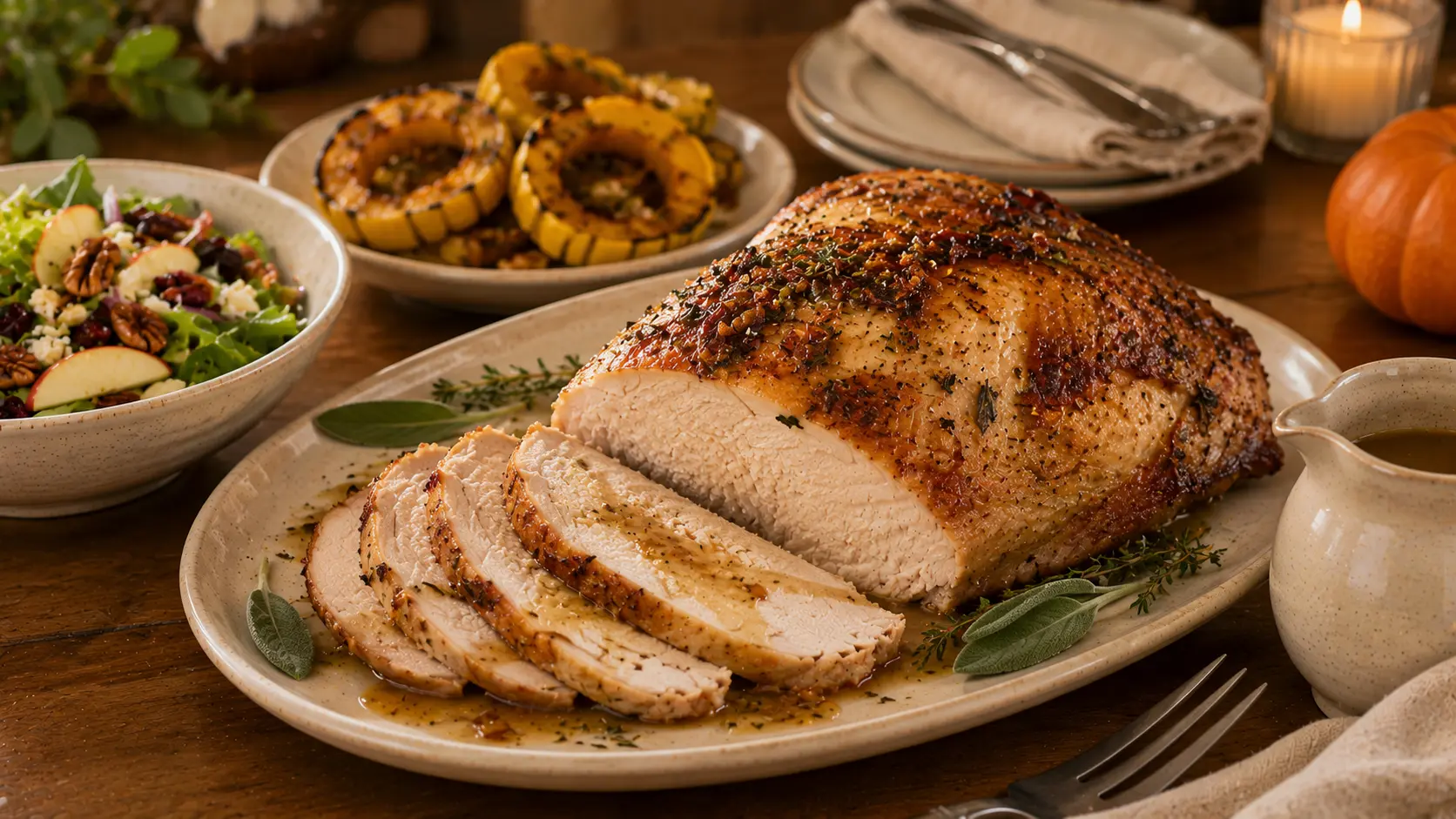
Brown Butter Sage Roasted Turkey Breast for Two
Ingredients
Method
- Make sure the turkey breast is completely thawed.
- Remove the turkey from the refrigerator approximately 30 minutes before preparation.
- Preheat the oven to 375°F (190°C).
- Place onion wedges, lemon slices, sage, and thyme in a small roasting pan. Pour in 1/2 cup broth.
- Pat the turkey breast thoroughly dry with paper towels.
- Melt the butter in a light-colored saucepan over medium heat.
- Continue cooking, gently swirling the pan, until the milk solids turn golden brown and the butter smells nutty. Remove immediately from the heat.
- Cool for 1–2 minutes, then stir in chopped sage, thyme, garlic, lemon zest, olive oil, salt, and black pepper.
- Carefully loosen the turkey skin from the breast meat without removing it.
- Spread approximately one-third of the brown butter mixture underneath the skin.
- Rub the remaining herb butter over the skin and exposed turkey.
- Position the turkey skin-side up over the aromatics in the roasting pan.
- Insert a probe thermometer into the thickest portion of the breast without touching bone, if using.
- Roast uncovered.
- Check the pan after approximately 30 minutes. Add a small splash of broth if the drippings begin to scorch.
- If the skin becomes deeply browned before the center is cooked, loosely tent it with foil.
- Continue roasting until the thickest part of the breast reaches 165°F (74°C).
- A 2 1/2–3-pound breast may require approximately 60–90 minutes, but rely on temperature rather than time.
- Transfer the turkey to a clean cutting board or platter.
- Rest for 15–20 minutes.
- Remove large herbs and lemon pieces from the pan juices and skim excess fat if desired.
- Carve the breast meat and slice across the grain.
- Spoon a small amount of warm pan juice over the slices and serve.